Spatial omics
Spatial omics Models
Spatially-resolved omics and tissue microenvironment modeling
99 models in this category
What spatial omics foundation models do
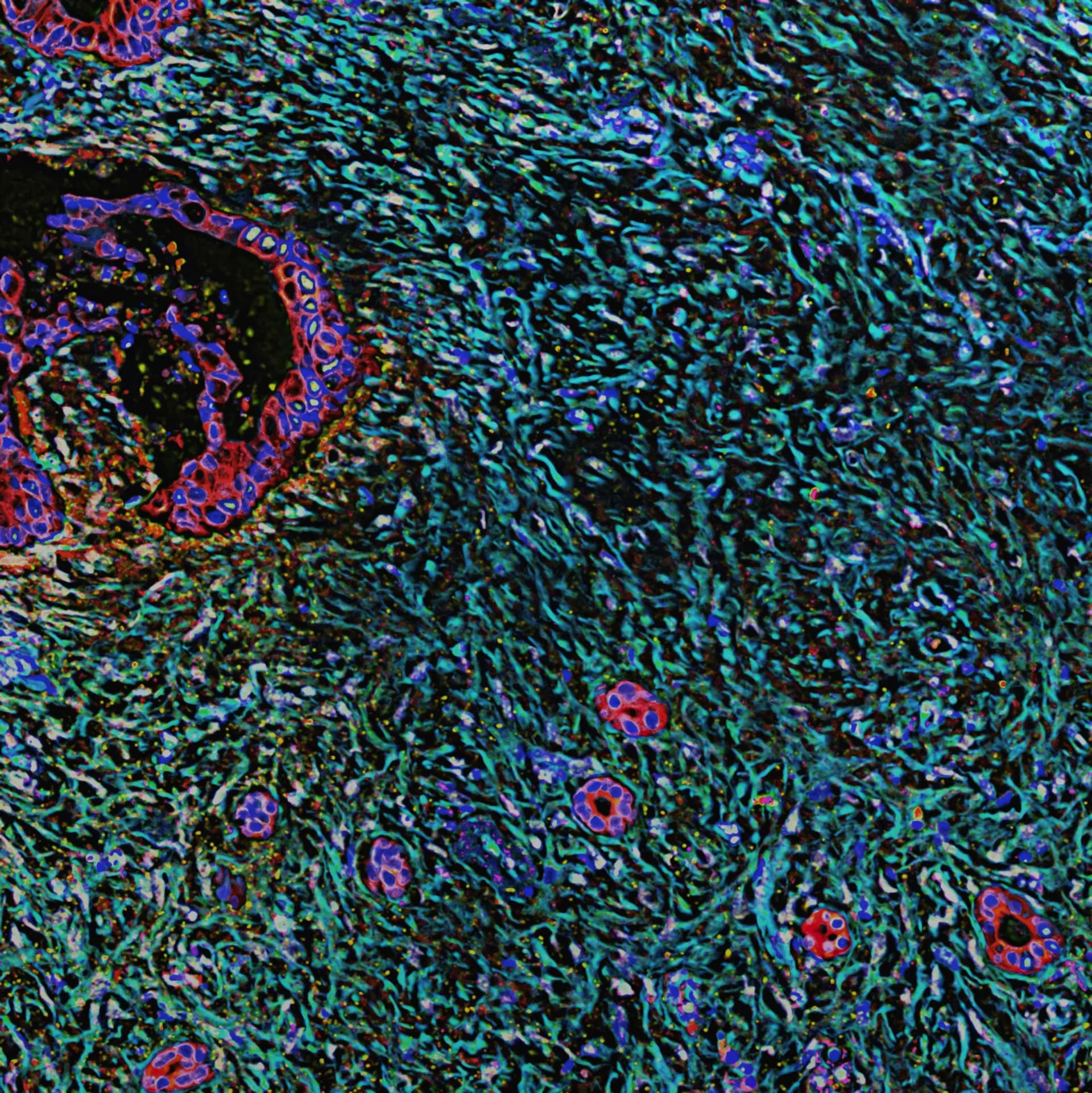
Spatial omics foundation models operate on measurements that retain their physical coordinates within a tissue, jointly modeling gene expression and spatial organization in samples from spatial transcriptomics platforms, histology images, and related multi-modal data. Unlike dissociated single-cell profiling, spatial models learn how neighboring cells influence one another and how expression patterns are organized across tissue architecture — information critical for understanding tumor microenvironments, developmental zonation, and tissue homeostasis. This class of models sits at the intersection of vision and sequence modeling, often combining image encoders with transcriptomics encoders.
Applications in tissue biology and disease
Spatial deconvolution — inferring cell type composition from spatial transcriptomics spots that capture mixtures of cells — is one of the most practically useful applications, helping researchers resolve tissue architecture from lower-resolution platforms. Histology-to-expression prediction models attempt to infer gene expression directly from H&E images, removing the need for expensive spatial sequencing in some contexts. Spatial models are also being applied to map cell-cell communication networks and identify spatially variable genes associated with disease progression in tumors and fibrotic tissues.
Notable Models
Top-rated spatial omics models from our evaluations
62—143
Spatial transcriptomics foundation model continually pretrained on 30 million profiles, with a protocol-aware mixture-of-experts decoder.
Spatial omicsSingle-cell
58Openness
35122214
Spatial proteomics foundation model, marker-aware and panel-agnostic, pretrained on 47 million multiplexed tissue-imaging patches from 175 markers.
Spatial omicsPathology
12Openness
35845—
Spatial proteomics foundation model for multiplex immunofluorescence, with a 268-marker vocabulary and marker-conditioned 768-dimensional embeddings.
Spatial omicsPathology
8Openness
19—11
Spatial transcriptomics foundation model aligning histology with gene expression at spot and neighborhood scale for zero-shot tissue domain calling.
Spatial omicsPathology
20Openness
Spatial proteomics foundation model that embeds every marker through its protein sequence, so heterogeneous antibody panels share one representation.
Spatial omicsPathology
79Openness
1721511
Spatial omics foundation model that represents tissue as a hierarchical graph of neighboring cells over per-cell gene co-expression networks.
Spatial omicsSingle-cell
83Openness
Frequently asked questions
What is a spatial omics foundation model?
A spatial omics foundation model is a neural network trained on spatially-resolved biological measurements — such as spatial transcriptomics data or matched histology and expression data — to learn representations that capture both molecular profiles and their organization within tissue architecture. These models support tasks like spatial deconvolution, histology-to-expression prediction, and tissue microenvironment analysis. The field is newer than single-cell modeling, and the number of available pretrained models is growing rapidly.
How is spatial omics different from single-cell transcriptomics?
Single-cell RNA-seq dissociates tissue into a suspension of individual cells before sequencing, losing all spatial information about where each cell resided in the tissue. Spatial transcriptomics platforms like Visium, Slide-seq, and MERFISH retain the physical position of each measurement, allowing researchers to map expression patterns onto tissue structure. Foundation models trained on spatial data can therefore learn cell-cell communication, tissue zonation, and spatial gradients that are invisible to dissociated approaches.
Can spatial omics models predict gene expression from histology images?
This is an active research direction, with several groups showing that vision transformer models trained on paired H&E and spatial transcriptomics data can predict the expression of hundreds of genes from image patches alone. Accuracy varies considerably by gene and tissue type — spatially variable structural genes are easier to predict than broadly expressed housekeeping genes — and current models work best within the tissue types represented in their training data.