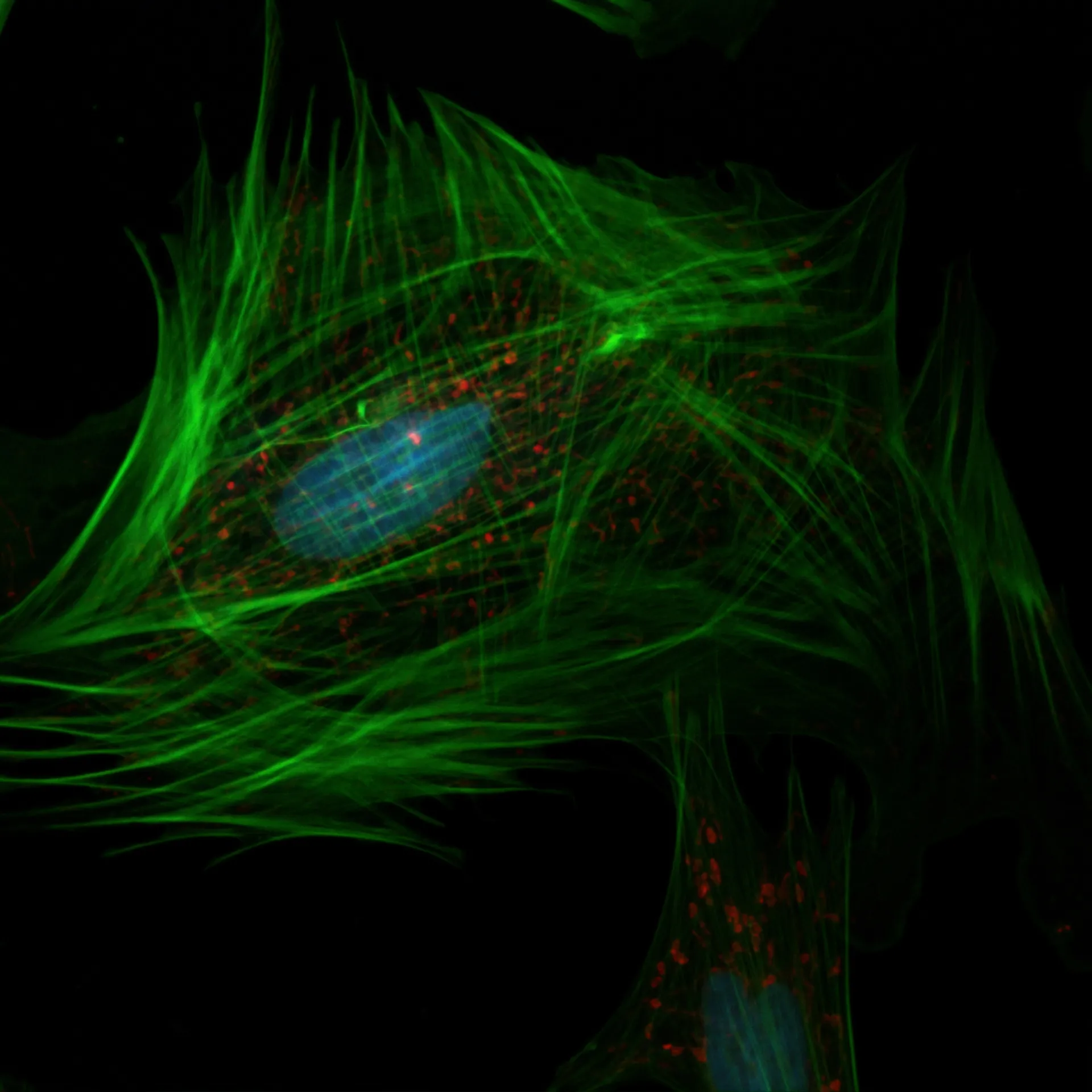
WaveOrder
A differentiable wave-optical framework for label-agnostic computational microscopy of biomolecular density and orientation across diverse imaging modalities.
Released: December 2024
WaveOrder is a computational microscopy framework developed by the Computational Microscopy Platform (Mehta Lab) at CZ Biohub San Francisco. It provides a unified, physics-informed, PyTorch-based library for designing and solving inverse problems in biological light microscopy — spanning quantitative phase imaging (QPI), fluorescence deconvolution, polarization-resolved imaging, and label-free modalities — within a single coherent mathematical framework. The paper describing the framework was posted to arXiv in December 2024.
The core challenge WaveOrder addresses is that modern biological microscopy operates across a wide range of physical principles: widefield fluorescence, confocal sectioning, light-sheet illumination, oblique illumination, and polarization-resolved imaging all require distinct physical models and reconstruction pipelines. WaveOrder unifies these under a differentiable wave-optical formalism, representing all linear optical properties with a shared mathematical language that allows gradient-based optimization to be applied across modalities. Rather than relying on large labeled training datasets, the framework uses physics-informed machine learning to auto-tune model parameters — including those governing spatially varying aberrations — and to solve blind shift-variant deconvolution problems without supervision.
WaveOrder has been validated across scales ranging from subcellular organelles to whole adult zebrafish, demonstrating its versatility in biological imaging contexts. It is deeply integrated into the CZ Biohub computational microscopy stack through the companion recOrder napari plugin, and both tools share OME-Zarr as their native data format. A model card and quickstart notebook are available on the CZ Virtual Cells Platform, positioning WaveOrder as a reproducible computational microscopy building block for the broader CZI research community.
Key Features
- Unified wave-optical framework: A single differentiable physical model spans widefield, confocal, light-sheet, and oblique label-free geometries, eliminating the need for modality-specific reconstruction codebases and enabling multi-contrast pipelines from one library.
- Physics-informed parameter estimation: Gradient-based optimization through differentiable forward models auto-tunes system parameters (e.g., point spread function shape, aberration fields) without requiring annotated training data, making calibration practical for diverse microscope configurations.
- Blind shift-variant deconvolution: Solves deconvolution problems in which the point spread function varies spatially — a key requirement for thick biological specimens and light-sheet systems — using a physics-constrained optimization approach.
- Quantitative phase and polarization imaging: Reconstructs biomolecular density (via quantitative phase) and molecular orientation (via polarization-resolved channels), providing label-agnostic access to structural information inaccessible with conventional intensity imaging.
- napari GUI and CLI integration: A napari-based graphical interface (
recOrder) enables interactive parameter exploration and visualization, while a configuration-file-driven CLI supports batch processing on HPC clusters, with both reading and writing OME-Zarr. - Multi-scale validation: Demonstrated on specimens ranging from individual organelles to whole adult zebrafish, establishing applicability across the full scale range of biological light microscopy.
Technical Details
WaveOrder is implemented in Python using PyTorch, enabling GPU acceleration and autodifferentiation through all forward model components. The framework represents the optical system through a linear transfer function model that encodes the pupil function, aberrations, polarization state, and illumination geometry. This representation is differentiable by design, so physical parameters can be optimized jointly with reconstruction weights via backpropagation. For fluorescence deconvolution, the forward model generates a spatially varying PSF from a parametric aberration expansion, and the corresponding inverse problem is regularized with standard priors (total variation, positivity). For label-free phase and polarization reconstruction, a Jones calculus-based model maps specimen birefringence and phase to raw intensity measurements across polarization states.
The library supports input data in OME-Zarr format, a community standard for multi-dimensional biological imaging that supports chunked, cloud-accessible storage. Benchmarks in the preprint demonstrate that the physics-informed approach recovers biomolecular structure beyond the limits of prior phase and polarization reconstruction methods, with improvements validated through both synthetic data with known ground truth and biological specimens including fixed cells, live cells, and whole zebrafish. The codebase is modular: core wave optics (waveorder), label-free imaging (recOrder), and the napari plugin can be installed separately or together, with all components publicly available on PyPI and GitHub.
Applications
WaveOrder is used by microscopists and computational biologists seeking quantitative structural information from label-free or multi-contrast imaging experiments. In the context of the CZ Virtual Cells Platform, WaveOrder provides the phase and fluorescence deconvolution preprocessing that feeds downstream cell modeling pipelines such as Cytoland. Researchers in cell biology use the quantitative phase channel to measure dry mass distributions and track organelle morphology without phototoxic dyes. The polarization reconstruction capability supports studies of cytoskeletal architecture, chromatin organization, and fibrillar extracellular matrix, where molecular alignment is the biologically relevant quantity. Core facilities and imaging centers can use the CLI for large-scale batch deconvolution of multi-well plate datasets or light-sheet acquisitions, taking advantage of GPU acceleration for throughput.
Impact
WaveOrder consolidates what has historically been a fragmented ecosystem of modality-specific reconstruction tools into a single well-maintained open-source package under the CZ Biohub computational microscopy umbrella. By grounding reconstruction in differentiable physics rather than supervised deep learning, it sidesteps the data requirements and generalization limitations that hamper purely data-driven approaches in low-throughput biological imaging contexts. As of early 2026, the framework remains a preprint awaiting peer review, and independent benchmarking of the physics-informed parameter estimation against dedicated calibration workflows has not yet been published. The tight integration with the CZ Virtual Cells Platform and napari ecosystem positions WaveOrder to become a standard preprocessing component for quantitative cell imaging pipelines as the platform matures.
Recent citations
Papers that recently cited this model.
Not enough citation data yet.
Top citations
The most-cited papers that cite this model.
Not enough citation data yet.
GitHub
Stars44
Forks9
Open Issues67
Contributors17
Last Push13d ago
LanguagePython
Fields of citing research
Not enough data
Openness
bio.rodeo opennessFully open · usable and reproducible
100OpenUsability — can I run it?99
Reproducibility — can I retrain it?100
Model Openness Framework
Class III
Open Model